
Industrial Parks: Where the Economy of the Future is Formed
Industrial parks are not just about production. They are about strategic planning, investments, infrastructure and, most importantly, about developing regions and creating a new quality for Ukrainian business. In the context of full-scale war, restructuring supply chains and reorienting industry, industrial parks are gaining special importance. 
We talked to Valery Kyrylko, CEO of the Industrial Parks of Ukraine group of companies, about how industrial parks in Ukraine work today, what challenges investors face, how interaction with the state is being established, and what prospects await this area. This interview is about practice, experience and a vision of the future that is being formed right now.
Prof Build: What would you consider to be the main advantages of industrial parks? What is the most important factor in the attractiveness of a particular industrial park?
— In order to understand the main advantages of industrial parks, it is necessary to understand what they are. Industrial parks are a separate designated territory where preferences and technical assistance from the state and tax benefits apply, as well as a land plot prepared to receive industrial and other enterprises that, according to the Law of Ukraine “On Industrial Parks”, have the right to operate on the territory of the industrial park. Accordingly, any participant or organizer of an industrial park receives a number of benefits from participating in such a project. In particular, as noted, this is receiving benefits, preferences, technical and financial assistance from the state. Thus, the state financially helps develop industrial parks in the following way: for the initiator of the industrial park and the management company that is engaged in the development of the industrial park by agreement, the state provides non-refundable financial assistance and partial compensation for the connection fee. This grant applies exclusively to engineering and transport infrastructure, such as: electricity, gas, water, sewage, treatment plants, roads and railway lines.
In turn, the following preferences are provided for participants, namely enterprises operating in the territory of the industrial park: exemption from income tax for 10 years, as well as exemption from import VAT and customs duty on equipment for participants registered in the territory of the industrial park in accordance with current legislation. From the point of view of the placement of participants in the industrial park, the benefits have already been calculated, and among the key ones is time saving. After all, when placed in an industrial park, any enterprise saves from 20 to 40% of its time on organizing a business, because a lot of the things that it would need to do when organizing its own enterprise are reduced due to the fact that the site has already been prepared, communications have been brought in, and there is a management company that can build, support, and design the real estate object for this participant. And then the participant can go about his business without thinking about security, cleaning, and maintenance of communications, which are provided by the management company or initiator.
The second benefit is saving money, because the project implementation time is reduced. As a rule, the management company or initiator already has experienced contractors who can build an industrial property for a fairly small amount of money, compared to market calculations, and, accordingly, the participant does not need to spend time on personnel or organization, etc. Accordingly, with this approach, real savings can be from 30 to 40%. There is also another unobvious benefit, namely, saving the participant’s nerves, which is a great advantage for locating in an industrial park.
When answering the question about the most important factors of the attractiveness of industrial parks, it is quite difficult to single out a more significant one. The attractiveness of industrial parks is formed by a combination of various factors. First of all, enterprises value the location of the industrial park, but each operator, participant who plans to locate in the industrial park, may have their own requirements. For example, the location of the industrial park in relation to raw materials, labor resources, suppliers, buyers and other support for a particular enterprise. Therefore, the location is evaluated first of all. At the same time, an equally important indicator is the logistics component. After all, a certain group of participants, say, desperately needs a railway branch, others – an international route or proximity to a port, etc. Therefore, although each participant has its own requirements, the general logistical convenience of the industrial park location is evaluated first.
The next indicator is the availability and readiness of the industrial park to accept participants. In particular, this is the presence of installed communications or their proximity to the industrial park, but it is better when the communications are installed and the connection points are already prepared. Next is the installed roads. Ideally, the main transit routes have already been laid through the territory of the industrial park, and this is a large attractive component of any industrial park. The next is the presence of already built industrial real estate. Because, as a rule, 80% of participants who plan to enter the industrial park expect that there are already real estate objects that they can enter. In the “old” or “new” – this is a secondary story. The main thing is that they are there. Among other factors: the presence of a professional management company, some synergy with existing enterprises, a specific ecosystem, etc.
Prof Build: Since the beginning of the full-scale war in Ukraine, a boom in the creation of new parks has begun. But despite such activity, there are a number of problems, the main of which is insufficient infrastructure development. Do you agree with this and what problems would you name?
— In fact, during the events I speak at, I always first talk about the fact that the development of industrial parks in Ukraine can be divided into two stages. The first stage is before the war, and the second is after it began, because before and after are completely different dynamics of development both in quality and scale.
Why did this happen? Because, as I mentioned earlier, industrial parks are primarily preferences, tax breaks, and a specially designated area. First, before the full-scale war, there were no preferences or state support for industrial parks in Ukraine.
Secondly, there was a rather low corresponding need from potential participants, because it did not matter to them where to locate – whether simply in an old industrial zone, whether to purchase a plot of land, or to locate in an industrial park. It did not have any particular advantages at that time.
In 2022 – not because a full-scale war began, but because it coincided in time – a package of documents was finally adopted that stimulates the development of industrial parks. And incentives appeared for both participants and initiators. Secondly, at the same time, a large number of relocated entrepreneurs appeared and began to look for land for themselves. Also, at the same time, demand from almost 1,500 entrepreneurs for prepared industrial sites in western and central Ukraine appeared.
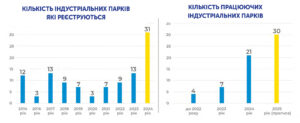
In addition, in 2023, for the first time in the entire existence of the industrial park market in Ukraine, the state adopted a decision on financial incentives for the development of industrial parks. In 2024, accordingly, a billion hryvnias were planned to support industrial parks. As a result, a little more was allocated – and this is good. 1 billion 260 million hryvnias were allocated for 15 industrial parks in 2024. And this also became an additional incentive for the initiators of industrial parks to start developing their parks.
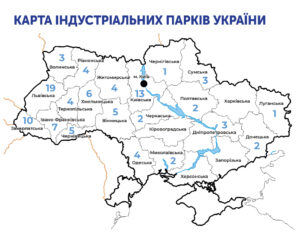
Given the above facts, a record number of 31 industrial parks were registered in 2024. And in total, almost 50 industrial parks were registered during the three years of the war. This is half of all industrial parks currently included in the register of industrial parks in Ukraine. Let me remind you that today there are 101 industrial parks.
Many people have started to develop three types of industrial parks. The first category is developers who developed industrial parks. A vivid example is the Vasyl Khmelnytskyi industrial park in Bila Tserkva. The second is municipal parks, which, seeing the prospect, began to register them for future enterprises. The third large category is the so-called industrial initiators, when the plant itself is the initiator of the industrial park and becomes the first enterprise or occupies the entire territory of this industrial park.
Regarding the problems that, in fact, exist. It is worth noting that it is impossible to generalize the problems for all industrial parks – they are very different.
If we talk about one of the key problems of the development of industrial parks, then, indeed, there are already prepared sites. These are sites to which communications have been brought, roads have been laid and the land plot is ready to receive future residents. But it should be understood that industrial parks are technically created on two types of sites: Greenfield – when it is a clean field, and Brownfield – an old industrial zone, usually from Soviet times, on the basis of which an industrial park is created.
So, with regard to the second category of parks (Brownfield), the situation with networks is much simpler and less problematic than in the first case. Because, as a rule, such industrial zones already have, albeit outdated, but still existing communications, roads, and land plots. The problem there is rather in the quality of the facilities located on the territory of such parks, because, as a rule, these are very worn-out, old, emergency buildings. But there may be no problems with communications there at all.
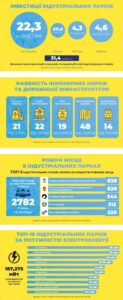
Problems with infrastructure concern primarily the first category – Greenfield. And this is a real challenge. That is why the state has begun to stimulate the solution of this problem. The 150 million hryvnias that the state provides for one industrial park are aimed specifically at providing the park with engineering and transport infrastructure.
The next global problem that I would highlight is that due to the novelty of the market, there are practically no formed and understandable teams or specialists ready to develop industrial parks. After all, the development of such parks is a complex task. This is both marketing to attract participants, and financing – attracting grants, investors; design of large-scale elements – both networks and facilities for future residents; construction, which must be done qualitatively and taking into account the needs of future companies. And in the future – it is managing the development of the park, creating an ecosystem, servicing residents, creating conditions for their growth.
All this must be learned, understood how it works, and acted accordingly to make the park successful. In Ukraine, unfortunately, the culture of creating such management companies or teams that can professionally develop industrial parks is only being formed. Yes, there are certain competencies – for example, in construction or design, but in general, many do not even understand where to start. In particular, in the field of marketing – everyone wants to attract participants, but only 20-30% of parks have their own website for their promotion. Almost no one knows about such parks, that they even exist in a particular area.
There is also a very low level of awareness among the audience that might be interested in industrial parks, regarding their advantages and the very fact of their existence. The more I speak at various events, not only related to industrial parks, but also to the development of industry in general, the more I am surprised at the low level of awareness of the audience, which hears for the first time that there is such an initiative in Ukraine.
Therefore, firstly, it is necessary to promote this topic both at the national and international levels, and at the local level – both among enterprises, factories, and among initiators, investors, owners of assets in the form of industrial zones or land plots.
Secondly, it is necessary to form a culture and train people who will do this: to develop networks of management companies that will professionally develop industrial parks. Access to investment should also be improved, as investment support for this sector can be a powerful driver of development.
Prof Build: In your opinion, who are the most active users of industrial parks? Why?
— User is a very broad concept. Let’s divide it. As I said, there are two main categories of entities operating in the field of industrial parks. These are initiators and management companies, as well as participants – that is, factories and enterprises that use the territory of the industrial park.
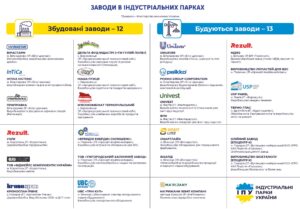
Accordingly, in the first category, the largest share of customers in terms of creating industrial parks today are industrial enterprises themselves, which create parks actually for themselves, for their own factories and businesses. They usually create two companies: one acquires a land plot, acts as the initiator and registers the industrial park, and the other is an enterprise that becomes either the anchor resident of the park or occupies the entire territory with its own production facilities.
According to our data, over 60% (and possibly more) of such customers are those who register industrial parks for their own production.
The second category is participants, and they can be divided by specialization. First of all, these are enterprises producing building materials. Demand comes from both foreign and Ukrainian companies, as everyone is expecting a large-scale reconstruction of Ukraine and is already preparing to produce building materials in sufficient quantities.
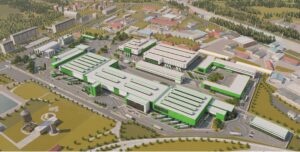
In second place are food industry and agro-processing enterprises. Today, there is a trend when many agro-holdings engaged in the cultivation of agricultural crops are moving to the processing industry, where these crops are transformed into value-added products. Specialized industrial parks are beginning to form around this.
The third category is logistics companies and warehouse real estate. Despite the fact that logistics and warehouses are not formally participants in industrial parks and do not fall under state preferences, the logistical advantages of certain parks attract such operators. They willingly enter the territory of industrial parks like other types of users.
It is also worth mentioning the enterprises of the defense-industrial complex (DIC). Today, there is very high demand, but the situation with them is more complicated and I will refrain from commenting for now.
Why do participants choose to locate in industrial parks? Obviously, because of the savings in money, time, nerves, as well as additional advantages, such as industrial symbiosis, convenient logistics and other factors.
Prof Build: How would you describe the prospects for industrial parks in Ukraine?
— I would characterize the further development of this area as a transition to a qualitative level. Quantitative growth has already occurred – we have a sufficient number of parks, and this is already shaping the market and enterprises that are interested in development within industrial parks.
But the next stage is high-quality industrial parks. Firstly, this is a transition towards environmental friendliness. The current Law of Ukraine “On Industrial Parks” has already included the concept of an eco-industrial park, and accordingly, environmental friendliness is becoming one of the main trends in the development of industrial parks.
Secondly, this is clustering or industry specialization of individual parks. This involves the creation of industrial clusters – for example, the food industry, metalworking, woodworking, furniture production, etc. Such examples already exist in Ukraine, and this trend continues to develop.
Thirdly, this is strengthening the industrial potential both at the state level and at the level of individual park participants. This involves more active promotion of this model among Ukrainian and foreign companies.
Fourthly, expanding financial instruments for the development of industrial parks: improving access to financing, guarantees, grant programs, etc. – to accelerate the development of this industry.
Fifthly, entering the Ukrainian market of foreign investors and industrial park participants. In international practice, one of the main indicators of the effective development of industrial parks is the presence and growth of the share of foreign participants. Therefore, it is expected that their presence in Ukraine will grow.
Another important direction is the increase in the number of network management companies that will be engaged in the professional development of industrial parks. For them, this will become a full-fledged business – development, construction, etc.
And finally, the consolidation of market participants: the creation of professional associations, public unions or clusters of industrial parks on a regional or industry basis.


